
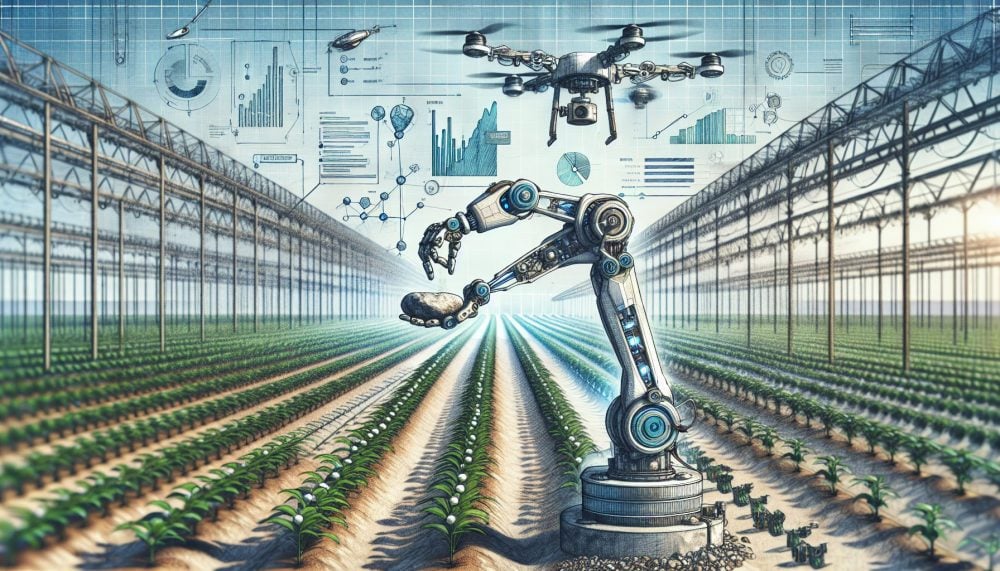
- Tension: Agriculture faces a structural labor crisis that technology promises to solve, yet 56% of farmers still report workforce shortages despite billions in ag-tech investment.
- Noise: Headlines celebrating funding rounds obscure the harder question of whether automation actually reaches the farmers who need it most.
- Direct Message: The most successful ag-tech companies don’t replace human workers; they transform punishing labor into manageable operations that humans actually want to perform.
To learn more about our editorial approach, explore The Direct Message methodology.
When TerraClear announced its $15 million funding round in April 2024, the agricultural technology press celebrated another win for farm automation.
The Bellevue-based startup had developed a system combining drones, artificial intelligence, and robotic implements to solve what many consider farming’s most universally despised task: picking rocks from fields.
Investors saw promise in the company’s approach of mapping field hazards with AI-powered aerial imagery before deploying mechanical solutions to remove them.
Two years later, TerraClear’s evolution from rock-focused startup to comprehensive field intelligence platform offers a revealing case study in what ag-tech funding can actually accomplish when directed at problems farmers genuinely need solved.
The gap between funding announcements and field results
Agricultural technology investment tells a compelling growth story. The agricultural robotics market reached $25 billion in 2025 and analysts project it will climb to $75 billion by 2030. Yet beneath these optimistic forecasts lies a more complicated reality.
The U.S. agriculture industry continues to grapple with approximately 2.4 million unfilled positions, and labor costs hit a record $53 billion in 2025. Immigration enforcement intensified these pressures, with farm employment dropping by 209,000 workers between March and May 2025 alone.
The tension reveals itself in everyday farm operations.
Rock picking exemplifies the brutal economics facing agricultural producers. Human crews typically miss 60% to 70% of rocks in a field while working at slower speeds than mechanical alternatives. A single buried boulder can destroy equipment worth tens of thousands of dollars or sideline critical machinery during narrow planting windows.
Medium to large farms incur anywhere from $5,000 to $150,000 in annual damage and labor costs managing this persistent problem. Multiply that across 300 million acres of U.S. farmland pocked with glacially deposited stones, and the scale of the challenge becomes clear.
TerraClear’s founder Brent Frei grew up picking rocks on his family’s Idaho wheat farm before building Smartsheet into a publicly traded software company. His return to agriculture wasn’t driven by nostalgia but by recognition that the problem he endured as a child remained essentially unchanged decades later.
Existing mechanical solutions like rock rakes and rock reels disturb soil and can only operate in limited field conditions, making them useless after planting.
When automation promises outpace agricultural realities
The ag-tech sector has generated no shortage of breathless predictions about autonomous farming. Industry forecasts routinely describe futures where robots handle everything from planting to harvest without human intervention.
These narratives attract investment capital but often overlook the practical constraints facing real farming operations. Complete automation in agricultural robots faces challenges of complexity and cost, with fully autonomous systems still working through technical hurdles for diverse field conditions and crop types.
The gap between demonstration and deployment remains substantial. Farmers operating on thin margins cannot afford experimental equipment that might work. They need proven solutions that integrate with existing machinery and deliver measurable returns within a single growing season.
The service model matters as much as the technology itself, particularly when labor shortages create immediate operational crises rather than abstract future challenges.
TerraClear’s approach evolved in response to these market realities. Rather than selling expensive equipment to cost-conscious farmers, the company developed a service-oriented model. Rock maps cost $2.95 to $3.95 per acre depending on timing and volume.
Farmers can use these AI-generated maps to guide their own selective hand-picking, or they can hire TerraClear’s crews with TC100 Rock Pickers at $2 to $9 per acre. This flexibility acknowledges that different operations have different needs and budgets.
The insight that changes operational economics
Technology succeeds in agriculture when it transforms despised labor into manageable operations rather than promising to eliminate human involvement entirely.
The testimonials from TerraClear users illustrate this principle in practice. One North Dakota operation reduced rock picking crews from nine people to one. A farmer working a 273-acre field cut picking time from six or seven hours with a tractor to just ninety minutes with a side-by-side using the map guidance system.
These aren’t stories of robots replacing workers; they’re stories of technology making difficult work dramatically more efficient and, notably, more tolerable.
The founder’s comparison to the invention of the weed whacker proves apt. When that tool arrived, people didn’t trim less; they trimmed more because the task became manageable. TerraClear users report similar expansion.
Having cleared obvious problem areas, farmers begin addressing rocks they would have previously ignored, reducing long-term equipment damage and improving overall field conditions.
From rocks to comprehensive field intelligence
TerraClear’s recent expansion reveals how successful ag-tech platforms evolve. The company now offers TerraScout, a fully autonomous scouting platform that captures ultra-high-resolution imagery for real-time map generation.
he same AI capabilities that identify rocks down to eight inches with centimeter-level GPS accuracy now detect weed species, density, and chemical effectiveness scores across fields. The platform is expanding into pest detection, disease identification, and crop nutrition monitoring.
This progression from single-purpose tool to integrated field intelligence system reflects broader agritech market trends.
Hardware captured 60% of agricultural robotics revenue in 2024, but software solutions are advancing rapidly as growers prioritize integrated decision support and cloud-based fleet coordination. TerraClear’s service model positions it well for this transition, maintaining ongoing relationships with farmers rather than pursuing one-time equipment sales.
Under CEO Devin Lammers, who joined from Farmers Business Network in 2024, the company has focused on commercial expansion across Iowa, Minnesota, Indiana, Illinois, and the Dakotas. Manufacturing partnerships with Minnesota-based Loftness Specialized Equipment and exploration of deals with major equipment manufacturers suggest ambitions beyond the startup phase. The company’s $53 million in total funding supports a 40-person team pursuing what Lammers describes as growing the concept into something much bigger.
For farmers navigating the structural labor challenges reshaping American agriculture, TerraClear’s trajectory offers a useful template. The company didn’t try to replace the entire agricultural workforce with robots. It identified one specific, universally hated task and developed technology that makes it bearable.
Workers who once spent days walking fields now spend hours. Equipment lasts longer. Fields produce better.
That practical improvement, achieved through accessible services rather than expensive equipment purchases, represents the kind of ag-tech progress that actually reaches working farms.